- 1
- 2
- 3
- 4
How can we screen for CV inflammation?
DETECTING CV INFLAMMATION
One blood draw. A more complete picture. When testing lipids, test for hsCRP ≥2mg/L to reveal the hidden risk
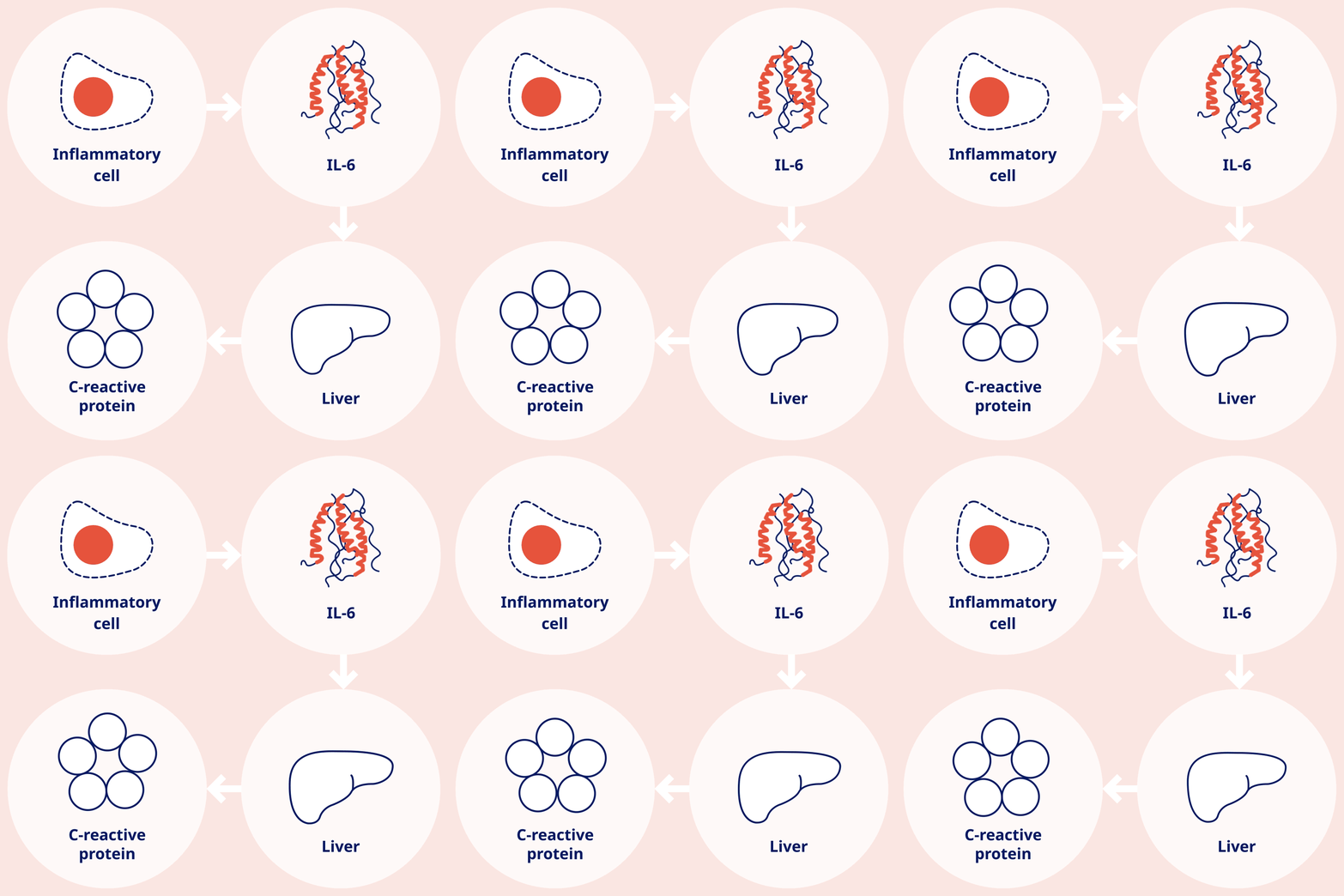
Cardiovascular (CV) inflammation is detected using high-sensitivity C-reactive protein (hsCRP), a simple blood test which can be done alongside routine cholesterol screening.16 hsCRP measures concentrations of C-reactive protein (CRP), a downstream biomarker of interleukin-6 (IL-6) – the driving force of CV inflammation.7,8
A 2025 ACC consensus statement recommends universal hsCRP screening in secondary prevention patients, stating that this presents a “major clinical opportunity” and should form part of “routine clinical practice”.15
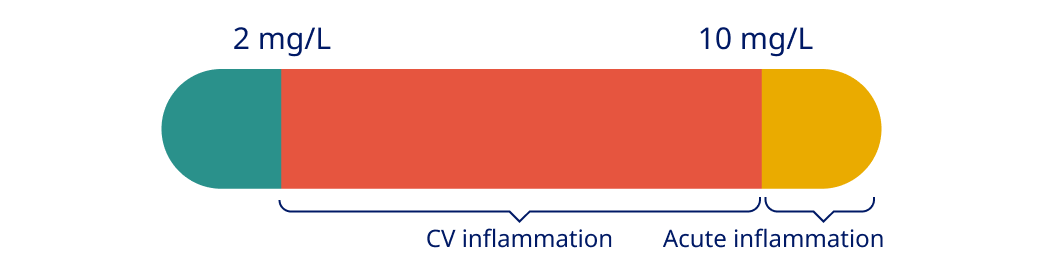
CV inflammation is identified when hsCRP is ≥2 mg/L9

≥2 mg/L
An hsCRP result below 2 mg/L is not considered an enhancer or modifier of CV risk.13,14

CV INFLAMMATION
An hsCRP result between 2–10 mg/L indicates CV inflammation is present and that a patient faces increased CV risk.17,19 This information should be used to guide treatment decisions and lifestyle management.

ACUTE INFLAMMATION
An hsCRP result above 10 mg/L indicates potential infection or acute inflammation, and a test should be repeated once this has subsided to assess CV risk.19
SCREAM STUDY
Understanding the threshold of 2 mg/L
The threshold of 2 mg/L has been repeatedly validated in large cohort studies. The SCREAM study found that in over 84,000 adults with atherosclerotic cardiovascular disease (ASCVD), those with hsCRP ≥2 mg/L, compared to those without, had increased risk of CV outcomes including major adverse cardiovascular events (MACE), heart failure, and CV death.12*
Patients with hsCRP ≥2 mg/L have increased CV risk as per AHA/ACC and ESC/EAS guidelines13,14

Risk modifiers for consideration beyond the risk estimation based on the SCORE2 and SCORE2-OP algorithms.
Biomarkers
Persistently elevated hs-CRP (>2 mg/L)
Adapted from: Mach F et al. 2025.

In adults with ASCVD with a borderline 10-year ASCVD risk estimate (3% to <5%) by the PREVENT-ASCVD equations, if high-sensitivity C-reactive proteins (hsCRP) is measured and is ≥2 mg/L on 2 successive occasions with no identifiable underlying cause of hsCRP elevation, high-intensity statin therapy can be useful to reduce the risk of ASCVD events.
Adapted from: Blumenthal R et al. 2026.

At a glance
- hsCRP is recognised as a modifier and enhancer of CVD risk in recent guideline updates from ESC/EAS and ACC/AHA13,14
- An hsCRP result ≥2 mg/L indicates increased CV risk7,9,18
- hsCRP testing can be done alongside cholesterol testing and should form part of routine practice15,16
Footnotes
*An observational study using data from the Stockholm CREAtinine Measurements (SCREAM) project included 84,399 adults with ASCVD between January 1, 2007–September 31, 2021. The study assessed the relationship between baseline hsCRP levels and risks of adverse CV outcomes and healthcare use. Regression models evaluated determinants and outcomes associated with elevated CRP (≥2 mg/L). Over a median follow‑up of 6.4 years, analyses adjusted for age, sex, time since ASCVD diagnosis, eGFR, albuminuria, comorbidities, prior revascularisation procedures, and ongoing CV medications. Compared with patients with hsCRP < 2 mg/L, those with hsCRP ≥ 2 mg/L had a higher risk of MACE (adjusted HR 1.30; 95% CI, 1.27–1.33), all‑cause mortality (adjusted HR 1.35; 95% CI, 1.31–1.39), and cardiovascular mortality (adjusted HR 1.29; 95% CI, 1.22–1.36), despite contemporary preventive therapy.12
Abbreviations
ACC=American College of Cardiology; ASCVD=atherosclerotic cardiovascular disease; CRP=C-reactive protein; CV=cardiovascular; CVDs=cardiovascular diseases; FDA=Food and Drug Administration; hsCRP=high-sensitivity C-reactive protein; IL-6=interleukin-6; LDL=low-density lipoprotein; MACE=major adverse cardiovascular events.
1. Feng Yet al. Front Cardiovasc Med2022; 9:818890. 2. Mehta N et al.Curr Atheroscler Rep2024; 27(1):12. 3. Katkenov N et al. J Cardiovasc Dev Dis 2024; 11(7):206. 4. SuJ et al. Front Pharmacol 2021; 12:745061. 5. Knopp T et al. Eur Heart J Open 2024; 4(4):oeae046. 6. Kurt B et al. CurrHeart Fail Rep2025; 22:35. 7. Ridker P. Circulation 2020; 141(10):787–789. 8. Sproston N& Ashworth J. Front Immunol. 2018; 9:754. 9. Ridker P et al. Lancet 2023;401(10384):1293–1301. 10. LamC et al. EurHeart J 2026. https://doi.org/10.1093/ejhf/xuag155 11. Navar Aet al. Atherosclerosis 2026. 12. Mazhar F et al. Eur Heart J 2024; 45(44):4719–4730. 13. Mach F et al. Eur Heart J 2025;46(42):4359–4378. 14. Blumenthal RS et al. JACC2026;87(19):2624–2757. 15. Mensah G et al.J Am Coll Cardiol2025;87:1381–1404. 16. Mayo Clinic. C-reactive protein test. Available at: https://www.mayoclinic.org/tests-procedures/c-reactive-protein-test/about/pac-20385228 17. Banait T et al. Cureus 2022;14:e30225. 18. Mazhar F,et al. EurHeart J Open 2026; oeag023. 19. Salazar J et al. Cardiol Res Pract 2014;2014(1):605810. 20. Pradhan Aet al. NEngJ Med 2022;387(21):1923–1934. 21. Bhatt D et al. N Engl J Med 2019;380(1):11–12. 22. Nicholls S et al. JAMA 2020;324(22):2268–2280.
This website intended for (non-US) Healthcare professionals.
The contents of this site are for education purposes and does not intend to substitute clinical decisions.
Date of preparation: July 2026
Jobnumber: HQ26CARD00082