- 1
- 2
- 3
- 4
How common is CV inflammation?
A recent global prevalence study investigated the presence of cardiovascular (CV) inflammation in patients with atherosclerotic cardiovascular disease (ASCVD), ASCVD with comorbid chronic kidney disease (CKD), or heart failure.7,8
2 IN 5 PATIENTS

~2 in 5 patients
had CV inflammation, defined as high-sensitivity C-reactive protein (hsCRP) ≥2 mg/L.7,8
THE POSEIDON STUDY
The POSEIDON study included over 18,000 patients from 18 countries across 5 continents. This global investigation gives a clear picture of the burden of CV inflammation.7,8 Despite a degree of regional and ethnic variation, the POSEIDON study has laid bare the true scale of CV inflammation and its presence in patients.7,8
Explore the prevalence of CV inflammation across the globe, as measured by % of patients with hsCRP ≥2 mg/L
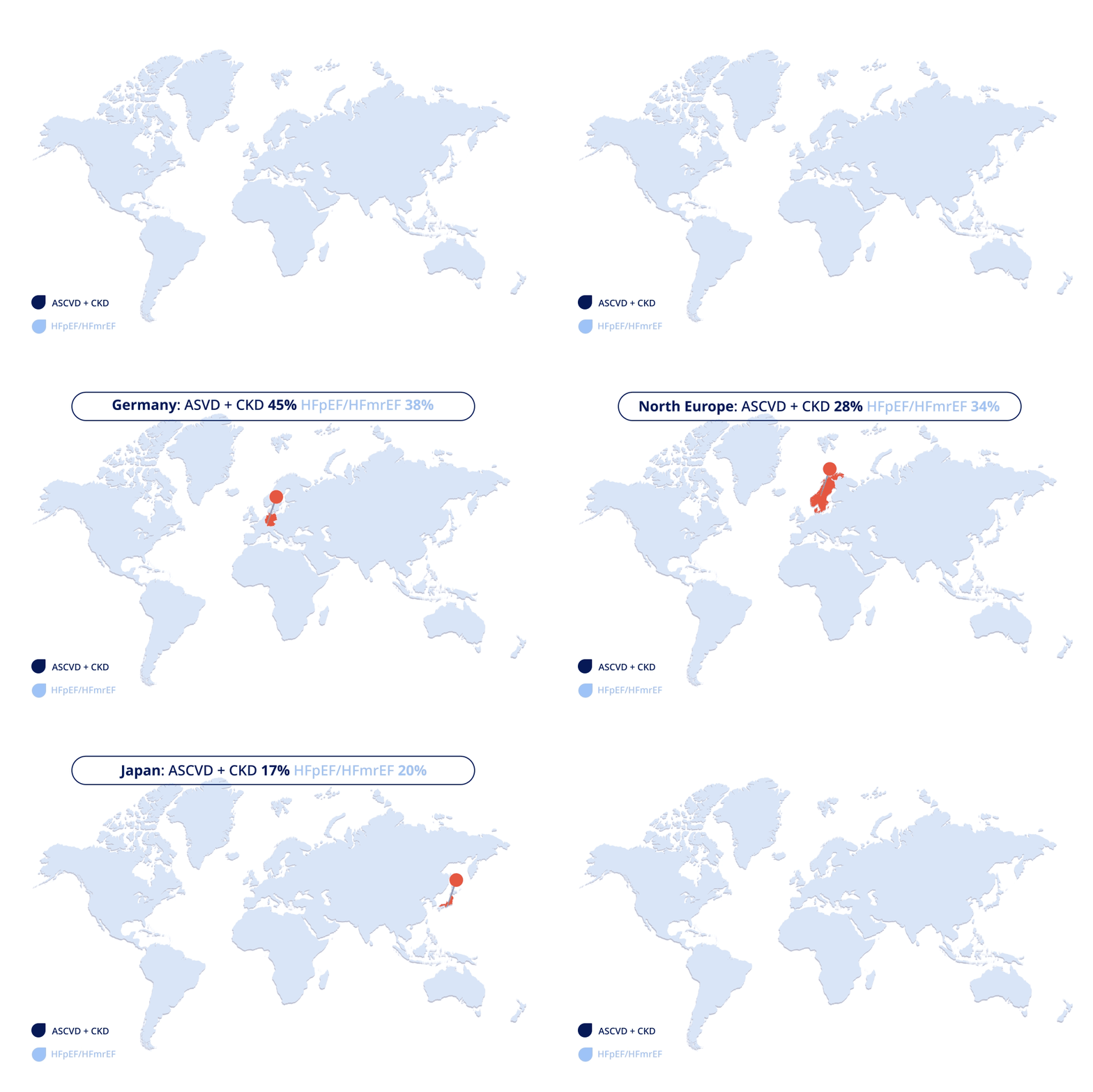
Adapted from: Lam et al. 2026 and Navar et al. 2026.
HSCRP TESTING
CV inflammation persisted in patients


These findings underscore the need for hsCRP testing to identify patients with CV inflammation to allow for better understanding and management of their CV risk.

At a glance
- CV inflammation is present in ~2 in 5 patients with ASCVD + comorbid CKD or heart failure globally7,8
- CV inflammation is present despite standard of care treatment7,8
- Testing for hsCRP ≥2 mg/L is crucial to identify this underlying risk9
Footnotes
*Prevalence of statin, ezetimibe, SGLT2i and GLP-1 RA use: in patients with ASCVD +CKD and hsCRP <2 mg/L the use of statins was 84.6%, the use of ezetimibe was 33.2%, the use of SGLT2i was 40.8% and the use of GLP-1 RA was 6.7%. In patients with ASCVD + CKD and hsCRP ≥2 mg/L the use of statins was 76.4%, the use of ezetimibe was 23.6%, the use of SGLT2i was 39.8% and the use of GLP-1 RA was 6.6%. In patients with HFmrEF/HFpEF and hsCRP <2 mg/L use of SGLT2i was 45.5% and GLP-1 RA was 4.6%. In patients with HFmrEF/HFpEF and hsCRP ≥2 mg/L use of SGLT2i was 45.1% and GLP-1 RA was 5.5%. Data were collected from over 18,904 patients across 18 countries.16,17
†Prevalence of BMI: in patients with ASCVD + CKD and hsCRP <2 mg/L 40.7% had BMI>27 and 20.5% had BMI>30. In patients with ASCVD +CKD and hsCRP ≥2 mg/L 51.1% had BMI>27 and 30.5% had BMI>30. In patients with HFmrEF/HFpEF and hsCRP <2mg/L 42.3% had BMI>27 and 22.4% had BMI>30. In patients with HFmrEF/HFpEF 49.7% had BMI>27 and 40.8% had BMI>30. Data were collected from over 18,904 patients across 18 countries.16,17
‡Prevalence of hypertension: in patients with ASCVD + CKD 82.1% of patients had hypertension in both the hsCRP <2 mg/L and hs CRP≥2 mg/L groups. Prevalence of Type 2 diabetes: 48.4% of patients with ASCVD + CKD and hsCRP <2 mg/L had Type 2diabetes, 50.7 % of patients with ASCVD + CKD and hsCRP ≥2 mg/L had Type 2 diabetes. 35.4% of patients with HFmrEF/HFpEF and hsCRP <2 mg/L had Type 2 diabetes, 39.8% of patients with HFmrEF/HFpEF and hsCRP ≥2 mg/L had Type 2 diabetes.16,17
§A collaborative analysis of 31,245 statin-treated patients who had or were at high risk of atherosclerotic disease from across the PROMINENT10 (n=9,988), REDUCE-IT11 (n=8,179), and STRENGTH12 (n=13,078) trials found that residual inflammatory risk was significantly associated with CV death (highest hsCRP quartile [>4.2–>4.8 mg/L] versus lowest [<1.1–<1.2 mg/L], adjusted HR 2.68, 95% CI 2.22–3.23; p<0.0001).15
#As measured by hsCRP >2 mg/L inpatients with ASCVD+CKD, or heart failure. The POSEIDON study was a global real-world evidence prevalence study which included 18,904 patients from 18 countries. It included patients with ASCVD with and without comorbid CKD, and patients with heart failure.16,17
Abbreviations
ACC=American College of Cardiology; AHA=American Heart Association; ASCVD=atherosclerotic cardiovascular disease; BMI=body mass index; CI=confidence interval; CKD=chronic kidney disease; CV=cardiovascular; CVDs=cardiovascular diseases; GLP-1=glucagon-like peptide-1 receptor agonist; HR=hazard ratio; hsCRP=high-sensitivity C-reactive protein; IL-6=interleukin-6;SGLT2i=sodium–glucose cotransporter 2 inhibitor.
1. Feng Y et al. Front Cardiovasc Med 2022; 9:818890. 2. Mehta N et al.Curr Atheroscler Rep2024; 27(1):12. 3. Su J et al. Front Pharmacol 2021; 12:745061. 4. Knopp T et al. EurHeart J Open 2024; 4(4):oeae046. 5. Kurt B et al. CurrHeart Fail Rep2025; 22:35. 6. Katkenov N et al. J Cardiovasc Dev Dis 2024;11(7):206. 7. Lam C et al. EurHeart J 2026. https://doi.org/10.1093/ejhf/xuag155 8. Navar A et al. Atherosclerosis 2026. 9. Ridker P. J Am Coll Cardiol 2018; 72:3320–3333. 10. Pradhan A etal. NEngJ Med 2022;387(21):1923–1934. 11. Bhatt D et al. N Engl J Med 2019;380(1):11–12. 12. Nicholls S et al. JAMA 2020;324(22):2268–2280. 13. Mach F et al. EurHeart J 2025;46(42):4359–4378. 14. Blumenthal R et al. JACC 2026;87(19):2624–2757. 15. Ridker P et al. Lancet 2023; 401(10384):1293–1301. 16. Lam C et al. Eur Heart J 2026. https://doi.org/10.1093/ejhf/xuag155. 17. Navar A et al. Atherosclerosis 2026.
This website intended for (non-US) Healthcare professionals.
The contents of this site are for education purposes and does not intend to substitute clinical decisions.
Date of preparation: July 2026
Jobnumber: HQ26CARD00082